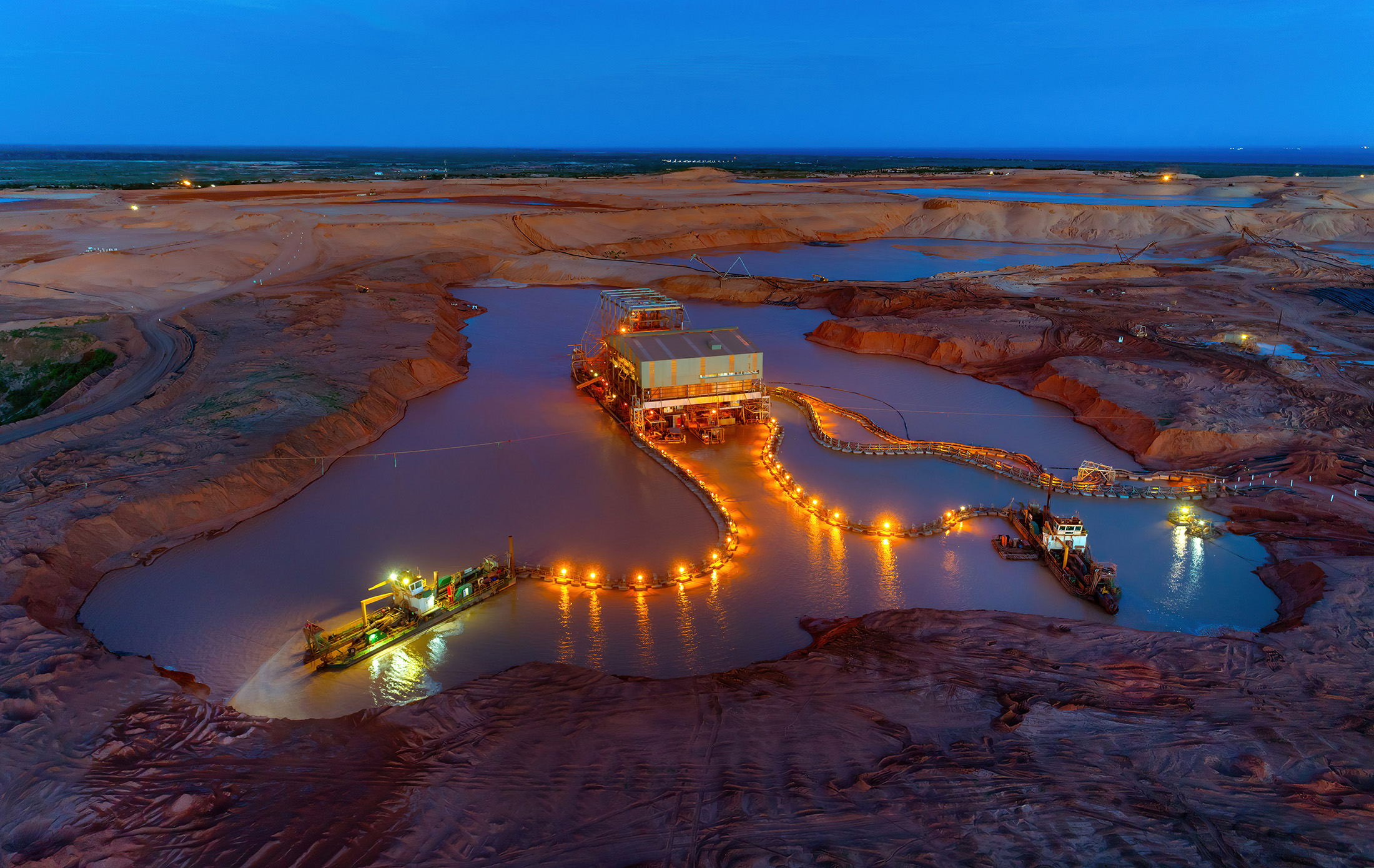
Moma’s operating process
Kenmare’s operational process is well-established and environmentally sound.
The Moma Mine is a low-cost, bulk mining operation that predominantly uses dredges to mine almost 40 million tonnes of titanium-rich sands per year. As part of this process, Kenmare progressively rehabilitates land and returns it to local communities.
Mining
Processing
Storage and export
-
Evaluation
The mine plan is designed and scheduled based on Kenmare’s Proved and Probable Ore Reserves. Kenmare is currently mining the Namalope and Pilivili ore zones, with WCP A due to begin its transition to Nataka in H2 2026.
-
Mining
Dredging takes place in three artificial ponds, where four dredges feed three Wet Concentrator Plants (A, B and C). The dredges cut into the ore at the pond’s base, causing the mineralised sand to slump into the pond where it is pumped to a WCP. Kenmare also has two dry mining operations to supplement ore feed to WCP A.
-
Wet Concentrator Plant (WCP)
The first processing stage at the WCPs consists of rejecting oversize material. Next, the ore feed is passed over progressive stages of gravity spirals, which separate the Heavy Mineral Concentrate (HMC) from tailings (silica sand and clay).
-
Dune Rehabilitation
Tailings are deposited into a series of settling ponds, dried and re-contoured, with the previously removed topsoil redeposited. Rehabilitation is completed by planting a variety of vegetation as well as food crops. The area is then transferred back to the local communities.
-
Heavy Mineral Concentrate
HMC is pumped to the Mineral Separation Plant (MSP), where it is stockpiled prior to further processing. HMC consists of valuable heavy minerals (ilmenite, zircon, rutile, and monazite, which is sold as part of Kenmare’s concentrates product stream), other heavy minerals, and a small amount of other minerals (the bulk of which is silica sand).
-
Wet high intensity magnetic separation
HMC is transferred from stockpiles by front-end loaders and fed to the Wet High Intensity Magnetic Separation (WHIMS) plant to separate magnetic from non-magnetic fractions
-
Magnetic gravity and electrostatic separation
The MSP uses magnetic, gravity and electrostatic circuits to separate the valuable minerals of ilmenite, rutile, zircon and monazite into individual products. The magnetic fraction of WHIMS output is dried and processed by electrostatic separation to produce ilmenite products. The nonmagnetic fraction of the WHIMS output passes to the wet gravity separation circuit to remove silica and trash minerals. Electrostatic separators are then used to separate the conducting mineral rutile from the nonconducting minerals zircon and monazite.
-
Product storage warehouse
Ilmenite and rutile are stored in a 229,000 tonne capacity warehouse, which also contains an enclosed area to store the mineral sands concentrate product (containing monazite). Zircon is stored in a separate 35,000 tonne capacity warehouse to reduce the potential for cross-contamination. The warehouses load the products onto a 2.4 kmlong overland conveyor.
-
Conveyor, jetty and transhipment
The conveyor transports product to the end of a 400 metre-long jetty, where product is loaded onto transshipment vessels, at a rate of 850 tonnes per hour. Kenmare owns and operates two transshipment vessels, the Bronagh J and the Peg.
-
Ocean-going bulk carrier
The vessels transport the products to a deep water transshipment point 10 km offshore, where they self-discharge into ocean-going third-party vessels. These vessels then transport the final products to multiple destinations around the world.