Climate change
Kenmare recognises that it has a responsibility to play a role in addressing climate change, alongside Governments and investors.
Kenmare accepts the scientific findings of the Intergovernmental Panel on Climate Change (IPCC); supports the goals of the Paris Agreement; and acknowledges that business has a role to play in addressing climate change.
In line with this position, the Company has set the ambition to achieve Net Zero by 2040 (Scope 1 & 2).
Kenmare established its first Climate Transition Plan in 2024, which sets a medium-term (2030) target of a 30% reduction in emissions (Scope 1 & 2) relative to its 2021 baseline, in alignment with requirements from the Corporate Sustainability Reporting Directive (CSRD).
Kenmare’s 2030 target is informed by but not aligned with limiting global warming to 1.5°C according to definitions set by the Science Based Target initiative (SBTi) the global standard for Net Zero targets. The target, which is not externally assured, is based on decarbonisation interventions related to Scope 1 emissions and adopts the market-based method for calculating Scope 2 emissions.
Kenmare does not envisage a linear reduction in GHG emissions between now and its stated targets in 2030 and 2040 but will more likely see fluctuations year on year in its GHG emissions with some possible increases before achieving 30% reduction in the target year. The (absolute) 2030 target reflects several challenges, outlined in more detailed in our Sustainability Statement, due to which Kenmare believes that the achievement of its medium-term target of 30% reduction by 2030 is currently under threat. Nevertheless, the Company remains committed to its pursuit, with its success dependent on capital expenditure availability.
For additional information on Kenmare’s approach to climate change, you can refer to the 2025 Sustainability Statement, the 2025 Sustainability Factbook and the Company’s Climate Policy.
Piloting biodiesel in Kenmare’s operations
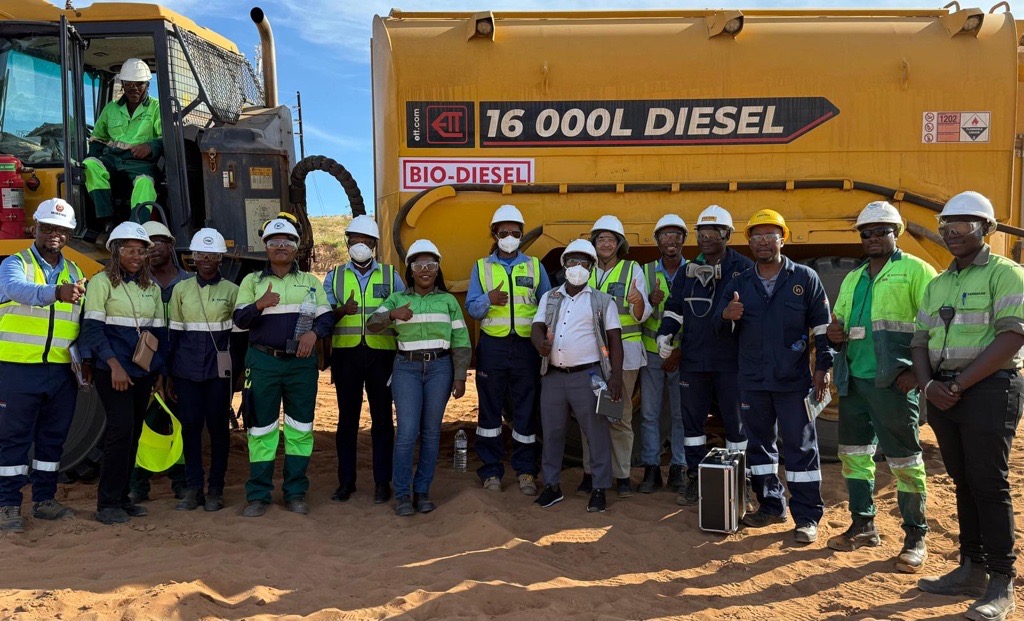
In 2025, Kenmare successfully completed its biodiesel pilot, trialling B10 and B25 in our Heavy Mobile Equipment and blends of B20 up to B60 in the High-Aluminium drier of the Mineral Separation Plant. Kenmare burned 45,000 litres of imported Used Cooking Oil Methyl Ester (UCOME) biodiesel in the pilot.
This project has delivered useful insights and inspired confidence that we can use biodiesel: an important step towards decarbonising our operations and demonstrating that Kenmare is playing its part in mitigating climate change. Kenmare’s next challenge is to identify and help develop domestic biodiesel sources.
Thanks to Dr. Senatla Jaane, Kenmare’s decarbonisation manager, for leading teams across the business to help deliver this strategically important pilot, as well as all those involved across operations, maintenance, projects, the Mineral Separation Plant and supply chain teams to help deliver this successful result.